In order to create an effective protest, we need to fulfil three goals within our outcomes – to make people sympathise with victims of child neglect, increase their overall awareness of the subject and offer them a way to get involved and make a change. In my previous post, I talked a bit about how organisations such as the Dubai Foundation for Women and Children used posters very effectively to fulfil those three goals and engage with people. Those posters featured the use of one or more child actors, however, which is something that we’ve discussed and unfortunately aren’t going to be able to use. The next best option is to use an object that symbolises children, invoking sympathy through the use of a visual metaphor.
A visual metaphor is a representation of an idea or a message that is presented through an image. Visual metaphors are frequently used within advertisement, inviting the viewer to think and take their own interpretation based on their understanding. I studied and examined several different visual metaphors within my Constellation studies, which in reflection, has proven invaluable in aiding this stage of the development process. One that has particularly retained my attention is a parody campaign run by Adbusters, who deconstructed posters created by Absolut Vodka.


Absolut Vodka frames their advertisements to create an image of their product that is high-end in nature, glorifying the consumption of their alcohol. This has its own implications, as over-consumption can be fatal. Adbusters took note of this and launched their own parody campaign, using visual metaphors to reveal the dangerous side of alcohol consumption.


Adbusters use the general shape of the bottle, framed in the centre of the image, with the same typeface and grid system as Absolut use in their posters to create an instant and effective visual metaphor that parodies Absolut’s posters. This is highly effective because it plays to the viewers favour, using their pre-existing knowledge to draw them into the metaphor before revealing the message of the posters – that over-consumption of alcohol isn’t great.
With these strong examples in mind, our group took to thinking about some visual metaphors we could create and use within our own campaign. Our first goal within our outcomes is to draw people in with an eye-catching visual metaphor. Based on the strengths of the existing examples we’ve looked at, we agreed that a object symbolising children would be a strong visual metaphor and a good place to start.


Some of my initial thoughts on what object to use involved building blocks, a children’s toy. These would have the potential to spell out messages, as each face of the block has a letter or a number. Using perspective, we could obscure some of the letters to create a sense of mystery, and the viewer would have to use their initiative to find the message. This entire process could represent how victims of neglect are often afraid to talk out about the problems they are facing, and it isn’t always clear to outsiders what is happening.
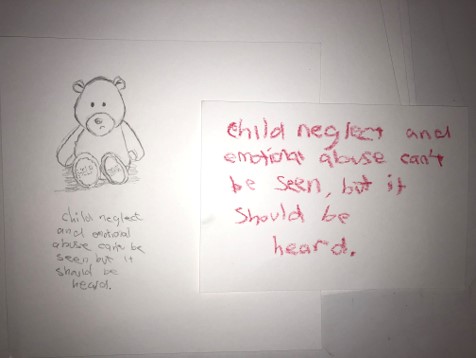
After some peer-review, we agreed that the image of a teddy bear would be very effective as it holds clear connotations of childhood and represents the more innocent side of it, invoking sympathy in a much stronger way. We thought about creating an illustrative outcome to capitalise on the skills the Illustration students have, but in the end, we decided to use photography to create a more realistic outcome that would be more adequate and impactful for the sensitive subject we’re handling.
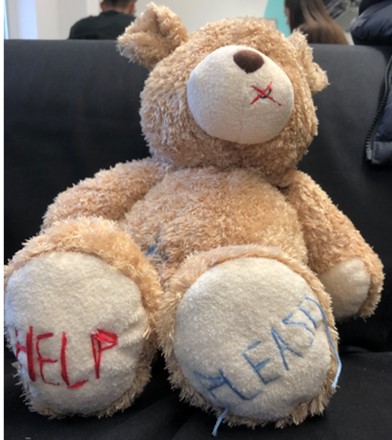
After purchasing the teddy bear, we decided to make some physical alterations to it that would represent our campaign better. This involved stitching the words “HELP” and “PLEASE” on each foot of the bear, as well as a small cross over the bear’s mouth. Initially, we were going to write “HELP ME” instead of “HELP PLEASE”, but felt that it wasn’t so clear in the context of our campaign what that message meant. The stitch across the bear’s mouth connotes a forced silence, which we intend to represent that victims of child neglect and abuse are often not heard or feel unable to speak up about the situation they are in.
With a strong visual metaphor created forming the foundations of the rest of our outcomes, we moved onto developing our manifesto – a poster that clearly displays the message of our campaign and a call to arms, and ultimately an invitation to get involved with our protest.
Sources:
Visual Metaphor: https://www.thoughtco.com/visual-metaphor-1692595
 BA (Hons) Graphic Communication - Journal