‘Punkism’ – Establishing An Invented Ideological Movement

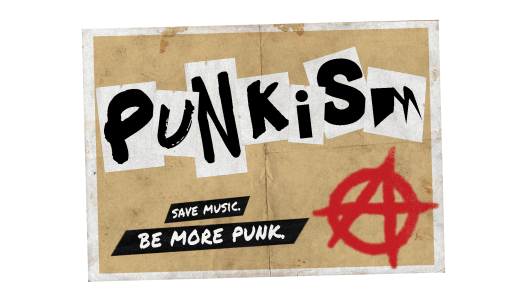
Punkism Logo

The brief for the Movement project was to invent a new ideological movement and create digital material that promotes, embodies and explains that movement. The only constraints were that the ideology must not exist, and that the digital material must be a piece  of movement – such as an animation or video clip.

I began approaching this brief by considering my own interests and beliefs – things that I would want changing in the world – in order to establish my own ideology. I was very quickly drawn to ideas situated around music, and more specifically so, the pop music industry; an industry whose practises and attitude towards music in general clash with my own. I’ve always seen the pop music industry as something that is purely focused on generating money – manufacturing music for profit, using the same recycled sounds and themes over and over again, essentially taking the heart and personality out of music. Music, like all art, is a platform for creative expression – and I feel as though the pop music industry is destroying and limiting this through its attitude. On the other hand, punk culture and music has always sought to rebel against this and put creativity and personality back into music, straying away from the norms. It was from these thoughts that I ended up on the idea of ‘Punkism’ – a movement dedicated to rebelling against the practises of the pop music industry and encouraging others to be a little more punk.

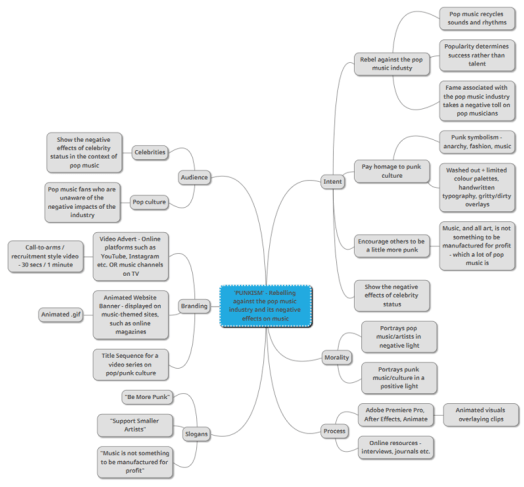
I created a mind-map in order to explore this concept further and give clarity to the movement, considering its intent, target audience, branding methods and processes of development.

Moodboard

Examining Movement Within Title Sequences

In preparation for the Movement module, I looked at five title sequences within film and television and examined their use of typography, image and sound and how they come together to create movement. My goal in this effort was to discover how movement can be used to create a strong identity for a piece of media, whilst also forging a lasting impression on a viewer.


#1: Game of Thrones (TV Series, 2011)

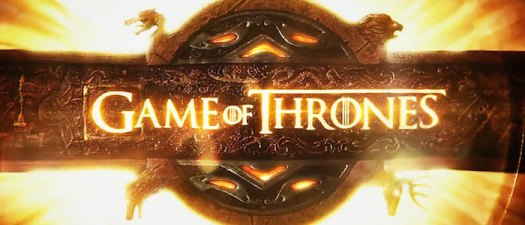
Game of Thrones Logo

HBO’s Game of Thrones’ lengthy title sequence is used to reveal the cast of the show whilst establishing the episode’s narrative. The leading cast members are revealed through a capitalised typeface with loose serifs and slight bevels to create a strong medieval style that matches the show’s themes. We are introduced to the episode’s narrative as the camera pans across an illustration of a map – the world of Westeros from the show – with medieval colouration present through soft greens, deep blues and bold golds. Three-dimensional models are animated to extend from the map in a clockwork-like manner, contributing to the establishment of the narrative by revealing locations from the show. These animations are accompanied by typographical illustrations on the map which further denote the show’s setting. The show’s theme song, a grand orchestral piece, creates a strong lasting impression as it builds up excitement as the sequence progresses, climaxing when the show’s title is displayed. This title is very similar to the subtitle text used to reveal the cast members –  a capitalised typeface featuring superior letters to reaffirm the sense of grandeur built up throughout the sequence. In effect, movement is used vigorously within this title sequence to establish the epic, fantastical narrative the show is built on.


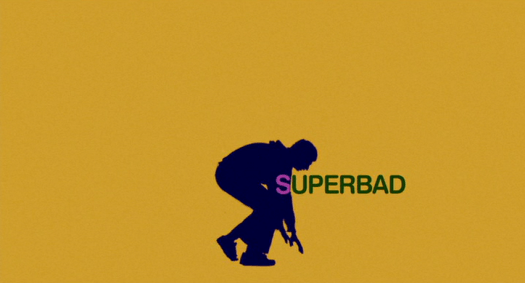
#2: Superbad (Movie, 2007)

Superbad Logo

Columbia Pictures’ Superbad features a short and simple titular sequence that serves to introduce the cast and production company, whilst infusing the viewers with a sense of what the rest of the movie will be about. Following the iconic Columbia Pictures logo, a simple colour range of bold primary colours is used alongside very limited imagery and simple typography. Imagery is used through the single-colour silhouettes of the human body that are placed against a contrasting background and is combined with movement. Movement is used effectively within this sequence in the form of the human body dancing, portraying a sense of casual fun and comedic elements that are prominent throughout the rest of the movie. Simple sans serif typography serves only to introduce the cast and production company – this is an effective use as it doesn’t detract away from the main focus of the sequence, that being the dancing silhouettes. The song “Too Hot To Stop” by The Bar-Kays is the musical piece that accompanies the sequence – a funky piece that emphasises the fun and comedic themes created by the moving images on-screen. Overall, Superbad’s title sequence is simple yet effective, using movement to introduce the movie’s cast whilst portraying the themes of the movie in a manner that creates a lasting impact on the viewers.


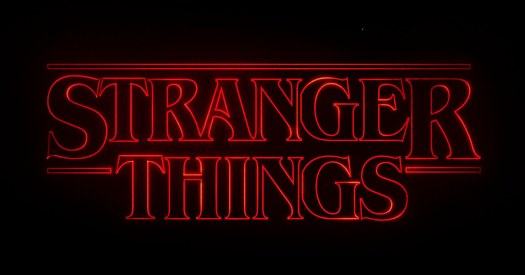
#3: Stranger Things (TV Series, 2016)

Stranger Things Logo

Netflix’s Stranger Things has a very simple title sequence featuring only two colours, simple typographical images composed against a plain background, and a short sci-fi-influenced piece of music. The sequence begins with darkness before the camera slowly zooms and pans to reveal glowing red outlines of letterforms. As the music builds up, the letterforms slowly glide across the screen – creating a sense of hypnosis –  before coming together to reveal the series’ logo as the music climaxes. The typography and soundtrack slowly fade out to close the sequence. The typography used within the sequence is capitalised serif, majuscule in effect, and features superior letters to create an apprehensive tone ready for the upcoming episode. The sequence is very reminiscent of Stephen King’s book covers, as well as title sequences from Star Trek – works of horror and sci-fi respectively, which the show is entirely themed around. Movement is used very delicately and slowly to infuse the viewer with the sense of mystery that the show is heavily based on.

Source: Radiotimes.com. 2017. Radio Times. [Online]. [Accessed 28 October 2018]. Available from: https://www.radiotimes.com/news/2017-10-28/whats-the-story-behind-the-nostalgic-80s-style-stranger-things-opening-titles/


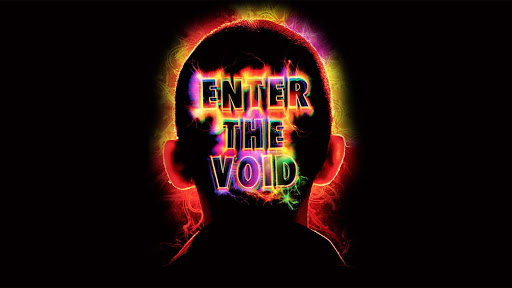
#4: Enter The Void (Movie, 2009)

Enter The Void Logo

Gaspar Noe’s Enter The Void features an incredibly rapid, vivid title sequence that is composed almost entirely of typographical elements. The first half serves to introduce the crew members behind the film, whilst the latter introduces the cast. Each individual typographical piece is designed to invoke the nature of the character or crew member. The first half features typographical elements that are sans serif, bold and majuscule in style that, combined with their large scale, invade the screen and create a strong lasting impression on the viewer – especially when considering the use of colour; rapidly changing and blinking between two or three different colours that are similar to a strobe light effect. The movement and pacing of each typographical piece is especially note-worthy, with each piece remaining on screen for less than a second yet still creating a strong impact on each viewer. A mixture of languages are used and are reflected within the typographical elements. The latter half of the sequence features a huge variety of different typographical styles – some lower-case and sans serif, others entirely upper-case and serifed, featuring a huge range of typographical techniques such as superior letters, ligature and bifurcated letterforms. Each typographical piece in this latter half serves to reflect the nature of the cast member and the character they portray within the movie. Overall, movement is used at an incredible pace within this title sequence to shock the viewer into remembering it – and with such a unique portrayal of a huge variety of typographical elements, it’s incredibly hard to forget it once a viewer has seen it.


#5: Bojack Horseman (TV Series, 2014)

Bojack Horseman Logo

Netflix’s Bojack Horseman features a short opening sequence that serves to introduce the themes and narrative of the show. It’s unique in the sense that throughout most of the sequence – excluding the beginning and end – the character Bojack is consistently positioned in the centre of the screen. His positioning and presence in the foreground establishes him as the main protagonist of the show, whilst supporting characters are seen in the background. We are introduced to the narrative and key themes of the show in the background – the lifestyle of a declining celebrity, their struggle to hold onto fame and their experiences with a normal lifestyle.  The sequence features a vivid and bold palette of colours that is reminiscent of the show’s setting – a fictional interpretation of Hollywood, highly glamourised. A jazz-style soundtrack accompanies the sequence which furthers this embracing of Hollywood. The typographical elements used are sans serif and comical in style, reflecting the context of the show – a cartoon. Overall, movement is used to establish key narrative elements and characters whilst portraying a good sense of the show’s themes, creating an instantly recognisable piece that is bound to stick within the viewer’s mind.


Re-imagining Design Histories – Development of the Art Deco Poster

With a firm understanding of the Art Deco movement and several initial ideas on how to design a poster to celebrate it, I concluded the research stage of the project and moved onto some preliminary sketches. Within these sketches, I aimed to complete several objectives:

  • Decide upon the poster’s layout, deciding between symmetrical and asymmetrical designs, working out a grid system that would be suitable for the three paragraphs, and figuring out the best visual hierarchy in order to create an aesthetically pleasing poster that properly celebrated the movement.
  • What illustrative image to use, how it can best celebrate the movement through metaphor, and the best way to fit that within the poster so that it dominates the main space yet maintains a sound visual hierarchy.
  • The style of typography to use to best celebrate the Art Deco movement.


Layout

I began my preliminary sketches focusing on layout, creating two symmetrical and two asymmetrical designs (one portrait and one landscape for each.) Whilst I’ve established that the majority of traditional Art Deco posters are symmetrical, I decided to experiment and see whether any new ideas could stem from some asymmetrical designs.
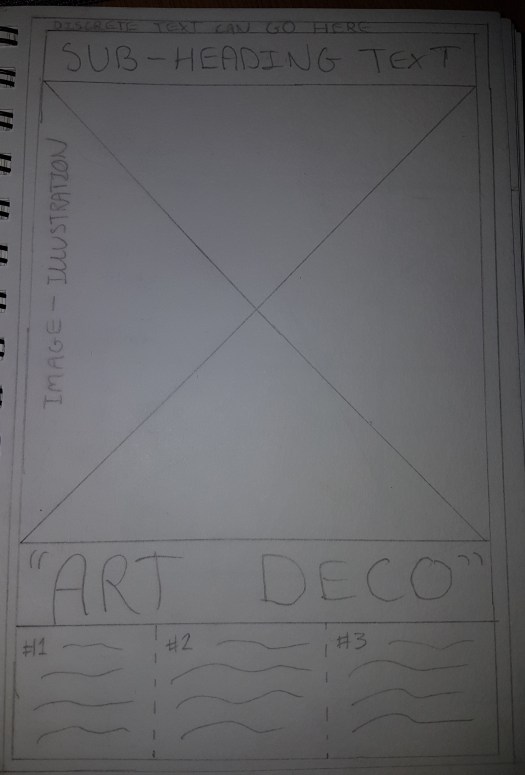
20181022_154719Symmetrical (Portrait) – the most traditional layout for Art Deco posters, I used a grid system with three columns and aimed to create a visual hierarchy that would first draw attention to the Art Deco title, then the image, then the paragraphs. This left room for a quote or subheading at the top as well as some discrete text within the outer border (a common feature within the majority of Art Deco posters), and thus I feel like this may be the strongest layout – it will best celebrate the movement best because of its inclusion of traditional features.


20181022_154637Symmetrical (Landscape) – a variation on the traditional symmetrical layout, I used a grid system of five columns and aimed to create a visual hierarchy that would draw attention to the image first. This would work well as my research proved the image should dominate the main body of the poster, however, I don’t think there is enough attention drawn to the titular text and paragraphs.
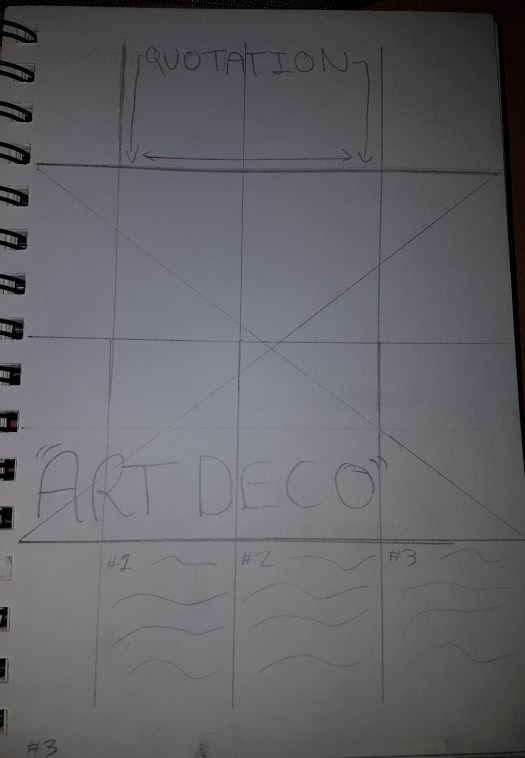
 

20181022_154803Asymmetrical (Portrait) – whilst not strictly asymmetrical (like posters within movements such as Constructivism or Dada), I aimed to create a layout that would still be effective for advertisement, as that is the key focus for traditional Art Deco posters – hence a loose symmetry within the above design. I used a grid system of four columns here, with the titular text overlapping the image. Whilst the visual hierarchy is strong, there are certain areas of the poster that are left empty, such as the bottom left and the header around the quotation. I believe this empty space would weaken the overall design, and if I am to develop this further, I would need to fill it.


20181022_154821Asymmetrical (Landscape) – more asymmetrical than the portrait variation, I decided to experiment by adding an extra image overlapping the first. There is a good path of the eye here over a grid system with four columns – the eye is drawn to the title first, then the image, then the paragraphs. Whilst incorporating most of the traditional features, this idea has its weaknesses – such as some empty space,  and not being suitable for advertising due to its slightly more confusing layout.

Overall, I feel the symmetrical portrait layout is the strongest idea (though a few tweaks can be made during the development stage), followed by the symmetrical landscape and then the asymmetrical portrait and landscape designs. Each design has their own strengths and weaknesses which I’ve done my best to identify here, and will take the various strengths into further development in order to create the best layout.


Typography

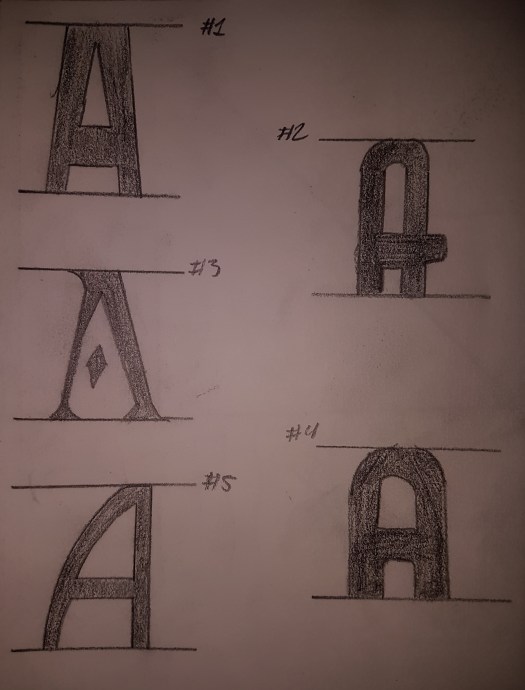
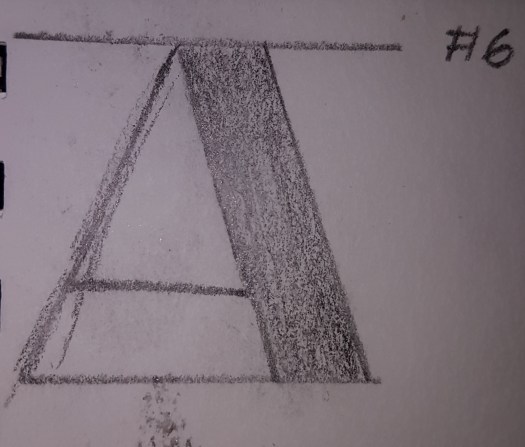
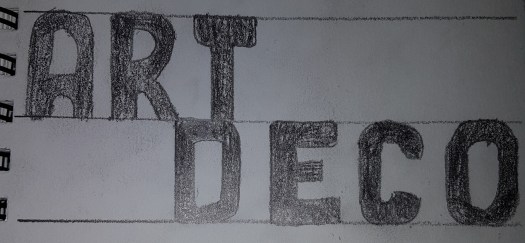
I continued with the initial ideas with some typographical sketches. As established within research, titular text within traditional Art Deco posters is typically majuscule and grand in style. Subtitles and smaller text depends entirely on the product being sold – and as I am not selling a product within my own poster, instead celebrating the movement, I believe it would be best to use a typeface that reflects the modernity of the movement for my paragraphs.
20181023_00063020181023_000705

#1 – A fairly simple majuscule letterform that conforms to the traditional typography used within the movement, but perhaps could be made a little more exciting and decorative for the poster in order to create a stronger aesthetic appeal.

#2 – A Broadway influenced letterform that celebrates the Art Deco movement rather well (one could draw a comparison between the typography used in Broadway advertisements and traditional Art Deco posters.) A strong contender for the titular typeface.

#3 – A decorative letterform that generally reflects the style of Art Deco, but perhaps is a little too complex for the poster celebrating the movement due to its lack of a crossbar – this might not translate well across other letterforms either.

#4 – A majuscule, geometric letterform that reflects traditional typography within Art Deco posters very well due to its simple, bold and angular form – something that draws attention extremely well, which is necessary within this poster. Another strong contender for the titular typeface.

#5 – An angular, majuscule letterform, similar to the fourth idea but slightly more decorative. This would probably work equally as well, but I’m drawn more to the above idea due to its geometric conformity.

#6 – Another Broadway influenced letterform that is more reflective of the late years of the movement, especially within America. Whilst effective, I believe this style of typeface to be quite cliche and used thoroughly throughout posters other than ones that celebrate the Art Deco movement, and thus may not be as effective as other concepts.

Upon careful reflection of these letter forms and with the opinion of peers, I decided to develop the fourth idea further into titular text due to its geometric and majuscule style, as well as being effective for commercial advertisement – perfectly celebrating the Art Deco movement.
20181023_003607

Regarding the typeface I’ll be using for the paragraphs, I decided upon Futura – a sans serif geometric typeface that reflects the modernity of the era and the geometry used within Art Deco posters. I initially thought about using Times New Roman or Myriad Pro, however, I do not feel these typefaces celebrate the Art Deco movement as well as a sans serif, geometric typeface.


Image

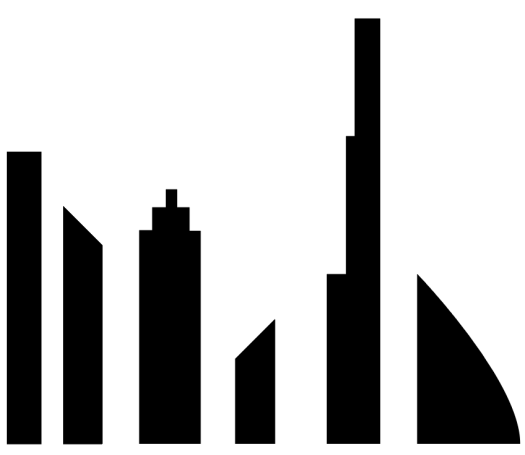
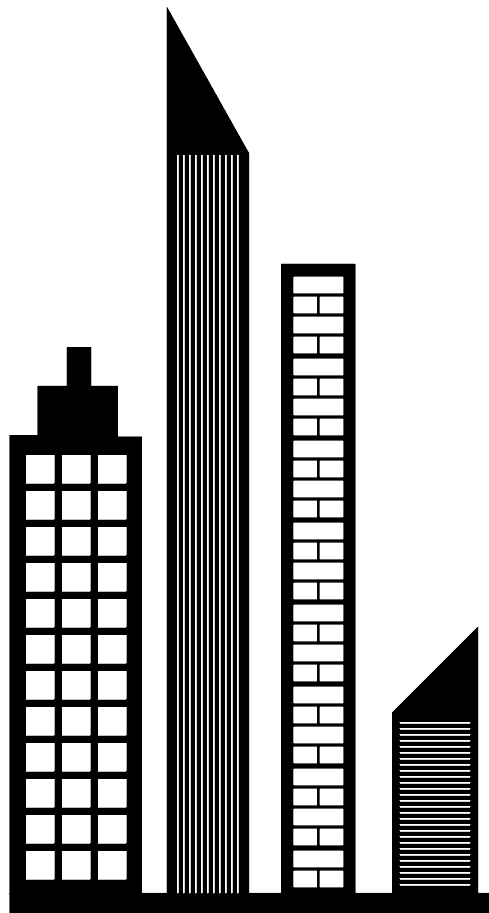
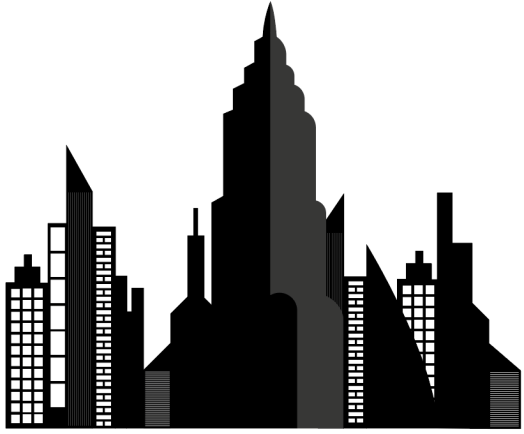
My initial ideas ended with what image I could use within my poster. From my research, I understand I need to create an image that is a metaphor for the movement – thus, an image that reflects the embracing of modernity and commerce. Fairly early on, I decided the image of a city skyline would reflect this rather well, as skyscrapers and taller buildings reflect modernity – the only thing I needed to further incorporate was commerce.

Instead of sketching these ideas, I decided to use the pen tool within Adobe Illustrator to create some vector images (creating a far more accurate portrayal of a skyline than my own sketches.)
2018-10-122018-10-12 (4)

I focused on creating some sharper vectors as well as angular ones that would create a sense of geometry within the overall poster, adding some finer details (such as windows and decals on the buildings) to add more depth to the image.

To compose the overall skyline, I used an image I created for the screenprinting workshop. This was a larger skyscraper that appeared three-dimensional through its shading of colour.

To add this to the overall image, I changed the red to black and orange to grey to match the greyscale theme so far (though colour would later be added to the poster within further developments.) I also decided to change some of the sharper strokes to angular ones, reflecting the angular strokes used within traditional Art Deco posters.

Once these final tweaks were done, I put all of the vector images together to create the final skyline used within the poster.
2018-10-15


Development of Initial Ideas

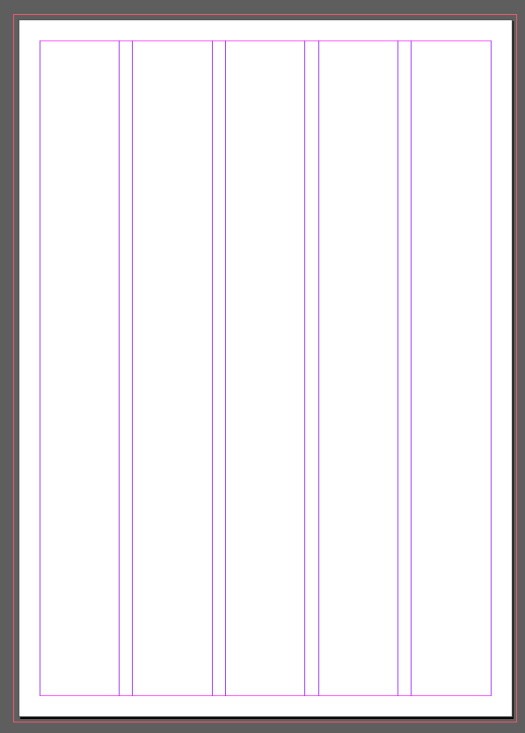
With a sufficient layout, typography and image decided upon, I began to approach the digital poster. Within Adobe InDesign, I created an A3 portrait document with a grid system of five columns. I decided upon five columns to better spread the paragraphs across the poster, as I feel three or four columns would not be enough to provide sufficient information on the Art Deco movement.
2018-10-23

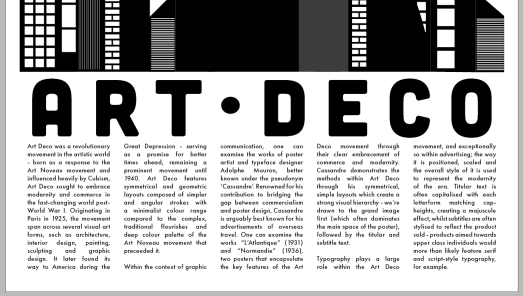
I then set to work on creating the titular piece of text. I used the typeface Cubano, an Adobe TypeKit font which best reflected the idea I settled upon within my typographical sketches. In order to best fill the empty space, I decided to use the polygon tool as I felt this would match the geometric style of the poster (though this would soon change.)

I then added the skyline image to the document, positioning it above the titular text in order to create a strong hierarchy. It was here I also decided to replace the polygons with a simple circular shape, increasing the tracking of the title to spread it across the A3 spread and filling the remaining space. I felt this was simply visually stronger than the polygons.

I then added the paragraphs to the grid system within the document, using the Futura typeface as decided upon earlier. I used an 11pt. font size, 20pt. tracking and justified text in order to create the smoothest visual distribution for the paragraphs:
2018-10-23 (5)

Paragraph #1:

Art Deco was a revolutionary movement in the artistic world – born as a response to the Art Noveau movement and influenced heavily by Cubism, Art Deco sought to embrace modernity and commerce in the fast-changing world post-World War I. Originating in Paris in 1925, the movement span across several visual art forms, such as architecture, interior design, painting, sculpting and graphic design. It later found its way to America during the Great Depression – serving as a promise for better times ahead, remaining a prominent movement until 1940. Art Deco features symmetrical and geometric layouts composed of simpler and angular strokes with a minimalist colour range compared to the complex, traditional flourishes and deep colour palette of the Art Noveau movement that preceeded it.

Paragraph #2:

Within the context of graphic communication, one can examine the works of poster artist and typeface designer Adolphe Mouron, better known under the pseudonym ‘Cassandre’. Renowned for his contribution to bridging the gap between commercialism and poster design, Cassandre is arguably best known for his advertisements of overseas travel. One can examine the works “L’Atlantique” (1931) and “Normandie” (1936), two posters that encapsulate the key features of the Art Deco movement through their clear embracement of commerce and modernity. Cassandre demonstrates the methods within Art Deco through his symmetrical, simple layouts which create a strong visual hierarchy – we’re drawn to the grand image first (which often dominates the main space of the poster), followed by the titular and subtitle text.

Paragraph #3:

Typography plays a large role within the Art Deco movement, and exceptionally so within advertising; the way it is positioned, scaled and the overall style of it is used to represent the modernity of the era. Titular text is often capitalised with each letterform matching cap-heights, creating a majuscule effect, whilst subtitles are often stylised to reflect the product sold – products aimed towards upper class individuals would more than likely feature serif and script-style typography, for example.

Sources:

  • Owen, Antoinette. “Treatment and Mounting of a Poster ‘Angleterre’ by A.M. Cassandre.” Journal of the American Institute for Conservation, vol. 24, no. 1, 1984, pp. 23–32.
  • Anonymous, 2011. Art Deco for a modern age. 1st ed. Cork, Ireland: Post Publications Ltd.
  • The Art Story. 2018. Art Deco Movement, Artists and Major Works | The Art Story. [ONLINE] Available at: https://www.theartstory.org/movement-art-deco.htm. [Accessed 8 October 2018].


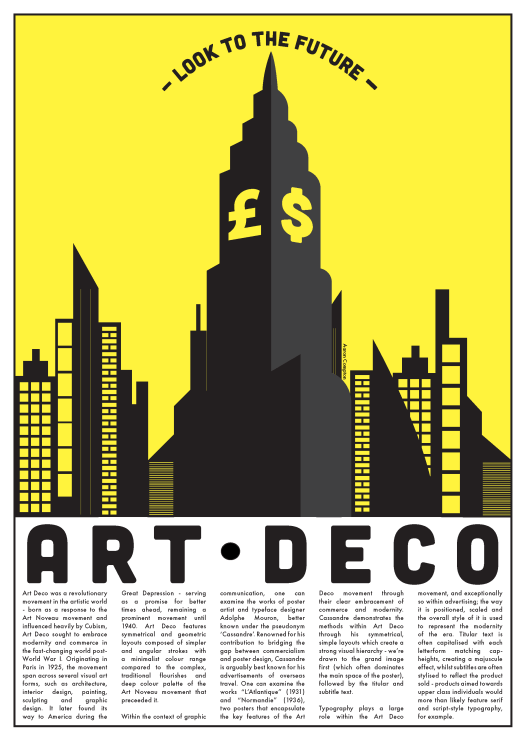
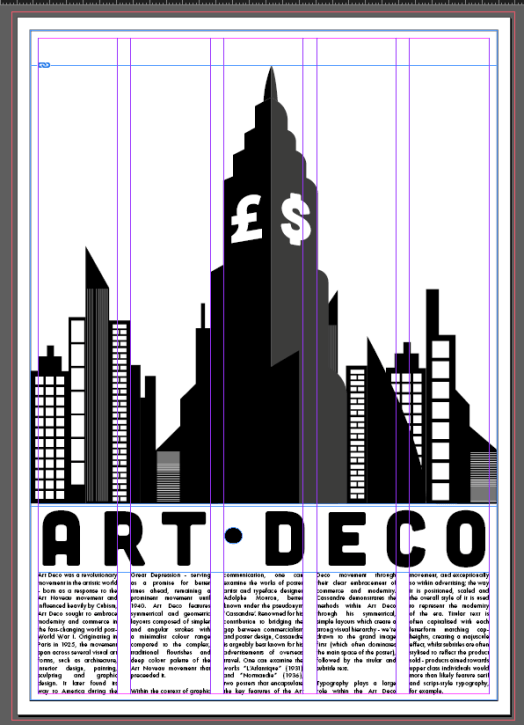
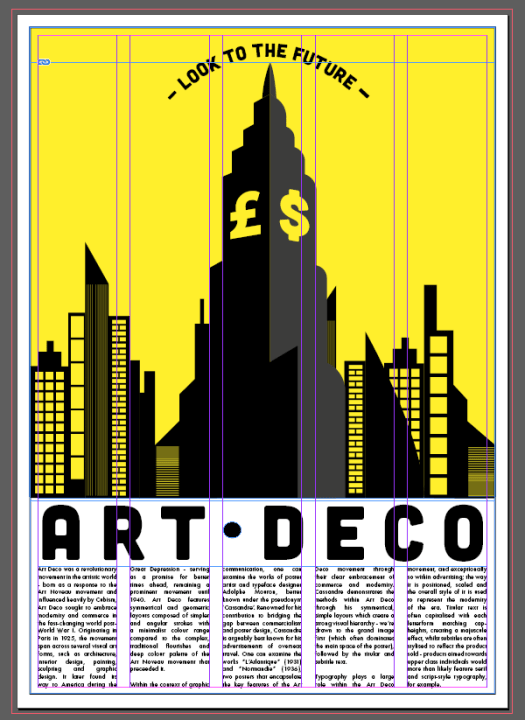
Reflecting upon the poster at this point, I noticed there was quite a lot of empty space at the top of the poster. I decided to increase the scale of the central skyscraper in order to create a stronger presence for the image, as well as visually represent commerce – something which I had struggled to incorporate up until now. I began by adding a simple dollar sign to the central building, but felt this was a little jarring to the path of the eye as it did not match well with the three dimensional effect I had created. To rectify this, I added two currency symbols – the pound and dollar sign – to each face of the skyscraper.
2018-10-23 (7)

With most of the key features incorporated into the poster, I was left to focus on a subtitle/quotation and colour. This actually proved to be one of the most challenging parts of the design process, as it was hard to represent colour distribution through my initial sketches.

Using an arced line and the type on a path tool, I used a simple slogan “Look To The Future” as I felt this neatly summed up the ideologies of the Art Deco movement. I added hyphens to either side of the text to create a slightly more grandeur aesthetic.

2018-10-23 (8)

One of the final steps before the final outcome was to add colour to the otherwise greyscale poster. Traditionally, Art Deco posters are fairly minimalist and use a small palette of colours. I was limited to two, however, and those colours would be the black shade of the image/text and the solid colour background. I tried a small range of CMYK colours suitable for print – a red, yellow and blue – and the choice became fairly clear. Red was very quickly ruled out as its connotations did not align with that of Art Deco. The decision between blue and yellow was fairly difficult, as I felt both provided that sense of modernity and hope for the future – though I eventually settled with yellow, due to its connotations of hope, grandeur and reliability.

A small finishing touch I added to the poster was a black frame, in order to create the white border effect seen in many traditional Art Deco posters.
2018-10-23 (10)


Final Outcome

Final for Print

PDF:

Re-Imagining Design Histories – Art Deco – Final Outcome [Aaron Compton]


Re-imagining Design Histories – Examining the Art Deco Movement

Art Deco was a revolutionary movement in the artistic world – born as a response to the Art Noveau movement, Art Deco sought to embrace modernity and commerce in the fast-changing world post-World War I. The movement originated in Paris in 1925, but quickly spread across Europe and even reached America during The Great Depression, serving as a promise for better times ahead – remaining a prominent movement until 1940.

The movement span across several mediums of visual arts, such as architecture, interior and furniture design, painting, sculpture and graphic design. Its purpose – to embrace the modernity and increasing commercialism in the world –  is reflected through often symmetrical and geometrical layouts, with simpler, angular strokes compared to the often complex, traditional flourishes of the Art Noveau movement prior. Notable works of architecture include New York’s Chrysler and Empire State buildings, but in the context of graphical communication we can examine the works of Adolphe Mouron Cassandre.


Cassandre incorporates all the core features of the movement within his poster designs, “L’Atlantique” (1931) and “Normandie” (1935). The posters are adverts for overseas trips, which instantly reflect the increasing focus on commerce and advertising that became prevalent in society following World War I. The layouts in both posters are symmetrical, following a simple grid system which creates an easy path of the eye – we’re drawn to the image first, then the titular typography followed by the subtext. Like all traditional Art Deco posters, Cassandre uses illustration over photographic image to convey the advert, featuring a small palette of colours which creates a minimalist effect. There’s not a lot of text used in either poster – something which I’ll need to consider when approaching my own design, as I need to incorporate three paragraphs without compromising the overall style of the poster – but the text used features a title with more information presented in the subtitles. The typography used here is all capitalised, and each letterform in a line of text have matching cap-heights, reflecting a majuscule typographical style. This technique creates a sense of grandeur when combined with the scale of the images, which conveys the overall message of the adverts perfectly – in the context of the era, a trip overseas would certainly be a grand ordeal.

Sources:

  • Anonymous, 2011. Art Deco for a modern age. 1st ed. Cork, Ireland: Post Publications Ltd.
  • The Art Story. 2018. Art Deco Movement, Artists and Major Works | The Art Story. [ONLINE] Available at: https://www.theartstory.org/movement-art-deco.htm. [Accessed 8 October 2018].
 

Poster Design

Displayed above are two more traditional posters from the Art Deco movement – on the left, Sam Hyde Harris’ Southern Pacific Daylight (1937) and on the right, Willem F.ten Broek’s Holland-America Line (1936). These posters, like the work of Cassandre, are an example of advertisement for travel and reflect the increasing communication around the world in the 1930s, ushering in a new age of transport. They too incorporate many of the traditional Art Deco poster characteristics – such as bold, majuscule typography for titular text, a minimalist colour range and a dominating image that creates a strong visual hierarchy.

Marcello Nizzoli’s Cordial Campari (1926) and Roger Broders’ Vichy Ses Sources (1928) are advertisement posters that aren’t as focused on transport, but rather commerce and the sale of a particular product. Within Nizzoli’s poster, the designer creates a strong visual hierarchy through his image and text placement, drawing the eye first to the bold majuscule “Campari”, then the product itself – which is made aesthetically appealing through its simple yet vibrant contrast with the luxurious red background. Broders’ work is a little different than the other posters I’ve examined so far and doesn’t feature a piece of titular text towards the lower half of the image – instead, this titular piece is scaled slightly smaller and distributed across the two right thirds of the poster to create an interesting asymmetrical appearance, especially so when also considering the size and placement of the “Sports”, “Tourisme” and “Theatre” text pieces. Whilst this is not traditional of Art Deco advertisement posters, the overall weighting of the poster is balanced out through the image – the figure on the left dominates the space, immediately drawing the eye to what the designer is intending to sell – thus, it is a successful experimental piece.


Research Methods

During one of the sessions last week, we explored the ways in which we can conduct research in order to underpin our projects throughout the rest of the course. Research is a vital part of any project – it is essentially the backbone of everything we create, supporting the decisions we make and how we can achieve a quality outcome. We must always consider the context we are creating in – who we are designing for, what we are designing with, and how we can fairly and responsibly create a piece of original work.

With this said, the session encouraged us to explore different ways of gathering research. In today’s age, one may jump straight to the internet and Google away – and whilst this is a valid method of researching, it’s quite a broad one, and often information can be false or biased. Furthermore, we do not always have the right to use what we find on Google. Copyright plays an incredibly important part within the modern world of media, and we must always be aware of rights and ownership. With these issues in mind, we had a look at another way of gathering valuable research – that being MetSearch, the university’s virtual library of research material. This system allows us to narrow down our search results and find more relevant information, as well as offering a plethora of information – such as books, articles and formal papers – to use as valid research with suitable references. Looking back, I believe that MetSearch offers a more varied and saturated approach to gathering research for our projects, and it’s a system I intend to use frequently when tackling projects.

The second half of the session supplied us with a task – we were to be given a graphic designer and a method of research, then asked to create a short presentation based upon the research we gathered. The group I was in were tasked with using the Cardiff Met Llandaff Library to study the working life of Paul Rand, an American graphic designer best known for his work in publishing, corporate logo design and advertising. Using MetSearch, we were able to retrieve 8 relevant results from the library (as opposed to the thousands that would appear online) and focused on using Steven Heller’s Paul Rand to underpin our presentation. We were able to examine various pieces of work by Rand, and considering I hadn’t ever seen his work before, we were able to pull a lot of information about his design processes.

The session concluded with the presentations of our findings, and we discovered a lot of new information about several designers – including Herbert Bayner, Gerd Arntz and Anthony Burrill – some of which I had never heard about before. The research context we were given all varied – some groups had the internet, others had the library and some had articles – and despite this, all presentations were saturated with valuable information. This proves that there is not just one way to approaching research when tackling our own projects. Before now, I had never really considered using a library to pull information about a specific task – I would always just use Google – but the session really heightened my awareness about different methods we can use to attain valuable information.


Sources:

Steven, H., 2000, Paul Rand, London: Phaidon Press Ltd.

‘Hybography’ – Experimenting With Hybrid Typography

Whilst not an actual word, the concept of hybography is that two separate typefaces can be merged together to create one, hybrid typeface – hence ‘hybrid typography’. As an example, one can take a serif typeface, cut out the serifs, and attach them to a sans serif typeface to create a new, hybrid typeface that is more interesting and dynamic; something that will stand out more to an audience and catch the eye.

The short workshop consisted of receiving a single word, and our goal was to visually convey its meaning through the way we presented it on the page – in a sense, using hybography to demonstrate meaning and ultimately creating an interesting piece of typography.

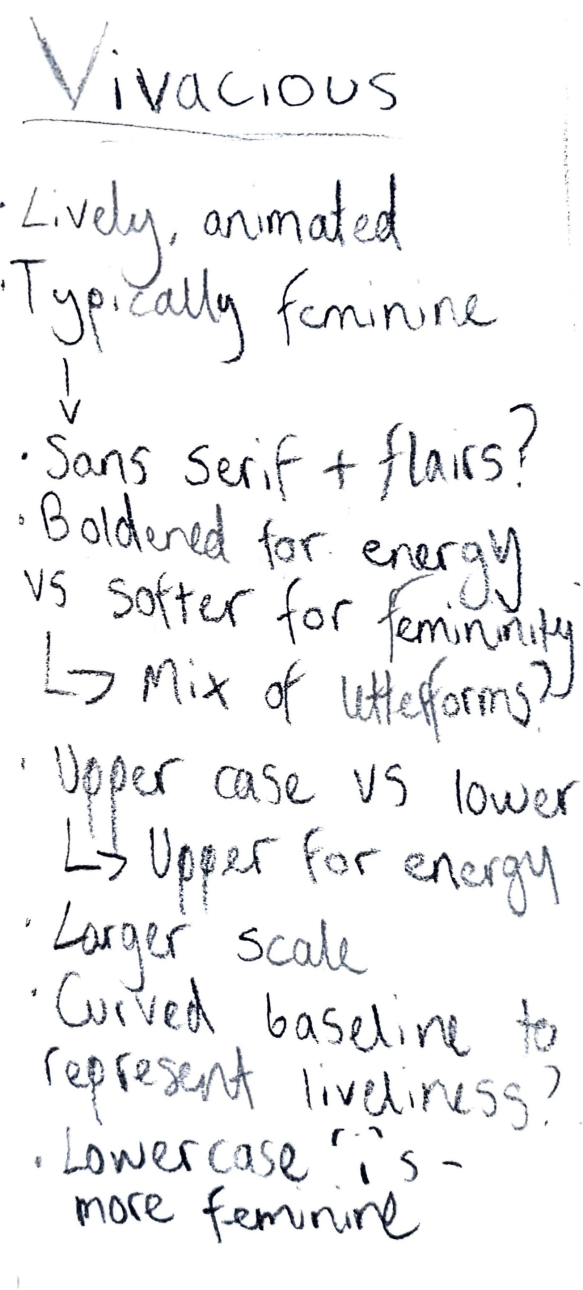
I received the word ‘vivacious’, and began by narrowing down its definition.

Vivacious Definition.png

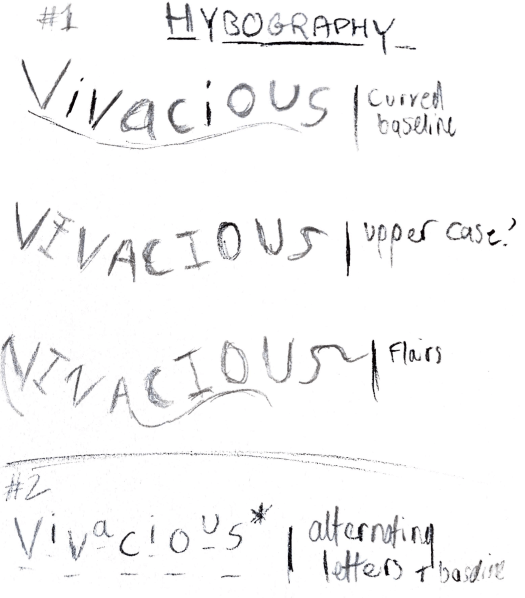
With the definition understood and some exploration into how best to represent the word, I began some quick preliminary sketches.

Preliminary Sketches

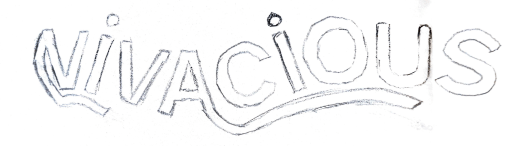
With these complete, and a general idea of the final design visualised, I constructed the final piece on A3:

Final Outcome_Page_2

I mostly drew from the style of my first three sketches, developing them into a typeface and adding a few hybographic features such as the flairs. Upon reflection, I would perhaps add serifs to some individual letterforms, such as the V and S, in order to convey the meaning of the word further whilst adhering to the rules of hybography. Overall though, I’m happy with the first attempt at experimentation, and will take the practices I have learnt into the development of our next project – the ‘Six Word Story’ poster.

Myth-making in Art & Design, Session One

The first session of Myth-making in Art & Design expanded my ideas and thoughts about the way I work and approach design tasks. We began the session by examining Plato’s ‘Allegory of the Cave’, in which Plato argues we only see a shadow of the world – what those who hold the power of influence intend us to see – and that we must learn to look past this in order to fully understand what we see. This concept cemented the foundations of the study group, and my understanding is that Myth-making intends to provide us with the means to be look past this shadow and be more aware of the bigger picture – thus vastly improving the quality of our work as designers.

The session progressed into an examination of Roland Barthes’ ‘Death of the Author’ theory, where he insists that once an author or creator releases a piece of work they lose all control of its meaning, and whatever purpose or intentions the author had are made almost irrelevant – it becomes entirely up to us as the public to interpret it and set the meaning. Reflecting upon this idea, it seems almost obvious that this is true – everyone interprets objects, concepts and ideas differently depending on the context of their life, such as their age, where they live, what they’ve experienced. This theory proves Barthes’ to be a post-structuralist – someone who believes that everything we are presented with is constructed, and that we must learn to look beyond the constructions. I would argue that my discipline is post-structuralist, and that we as graphic designers must be completely aware that everything we produce will be viewed by a variety of audiences and interpreted differently. Thus, I think it’s almost necessary to be post-structuralist as an individual to fully understand my discipline.

Following this, we examined an essay by Barthes’ on the nature of plastic, and its ability to be anything and everything. Barthes’ believes plastic to be “the stuff of alchemy” – “the transmutation of matter” – and that its power lies in imitation as opposed to actual use. Though written in 1957, these concepts could still apply today as our world is still saturated in the unnatural material, and Barthes’ ideas on its malleability spawned several thoughts on my own discipline. Though in Graphic Communication we focus more on the visual nature of design as opposed to physicality, material is still something we must always consider in our practice – and plastic, though powerful and cheap, perhaps can be replaced with other natural materials that have the same effect.

Upon reflection, the session has expanded on my understanding of how I must approach my projects within Graphic Communication – everything I create will be interpreted differently depending on the context of who the audience is, where they are and what they have experienced. Though we will hold the power of influence, we must be aware of the polysemy of our discipline and use it responsibly within our ever-changing world. With that said, I’m looking forward to the sessions to come and hope that my understanding of my discipline continues to expand.


Sources:

Barthes, R., Plastic in ‘Mythologies’, Vintage, 2009, pp. 97-99

Typographic Terminologies

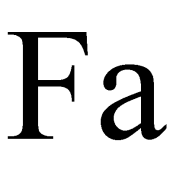
SerifSerif

Serif typefaces are typefaces which include strokes with small lines (feet) at the end of them, as shown circled in red. The inclusion of serifs can affect the style of a typeface immensely, creating a more formal, embellished look. (Font: Times New Roman)


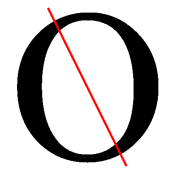
Old FaceOld Face

Old Face typefaces were originally created around the late 15th century, and are characterised by letterforms with curved strokes and little difference between thick and thin strokes. They also often include letterforms with diagonal cross-strokes, similar to Humanist typefaces, which mimic the natural handwriting of humans. (Font: Times New Roman)


Transitional Transitional

Transitional typefaces rose to prominence at the start of the 18th century and feature a strong contrast between thick and thin strokes. They have wider and sharper serifs than Old Factypefaces. (Font: Garamond)


Humanist

Humanist

Humanist typefaces, similar to Old Face typefaces, appeared in the late 15th century and are characterised by their reflection of the human handwriting style through thinner strokes (shown in the diagram with the red stroke.) They also tend to have a fairly small x-height. (Font: Times New Roman)


Script

Script

Script typefaces often reflect calligraphy with their attention to curved strokes, once again mimicking the human hand and the nib of a pen. The style of the typeface promotes elegance and may often be seen in formal invitations or event advertisements. (Font: French Script MT)


Roman

Roman

Roman typefaces are based around the inscription of letters into stone, the serifs reflecting the work of a chisel. They rose to prominence in the 15th century and their style promotes a sense of antiquity. (Font: Garamond)


Italic

Italic

Italic typefaces are used to indicate importance via the slant in each individual letterform, drawing attention to certain parts of text. (Font: Georgia)


Majuscule

Majuscule & Miniscule

Majuscule typefaces include letterforms which are usually capitalised, and all letterforms pertain to the same height. This is to ease readability. Miniscule typefaces have a similar purpose, but they tend to be lowercase, pertain to the same height and are designed to be legible at small sizes. (Font: HWT Artz)


Geometric

Geometric

Geometric typefaces are made up of strokes that all hold the same weight, and are based on circular and triangular fonts. They reflect a clean and mathematical style. (Font: Futura PT)


Condensed

Condensed

Condensed typefaces are taller than they are wider, and can be used to fit a lot of information into small areas of print or screen. Typically, you may see condensed typefaces used in film posters, crediting the crew and cast. (Font: Origin Super Condensed)


Ligature

Ligature

A ligature typeface is where two individual letterforms join together to create one glyph, creating a similar style to script and calligraphic typefaces. (Font: Times New Roman)


Gothic

Gothic

Gothic typefaces often contain complicated letterforms with thick stroke weights to create a sense of dread or unease. Derived from Carolingian Miniscules, the typefaces can often be illegible. (Font: Amador)


Slab Serif

Slab Serif

Slab Serif typefaces contain letterforms with strokes that all hold the same weight, similar to Geometric typefaces, but also hold serifs which create a more formal and embellished style. They are also known as Egyptian typefaces. (Font: Mislab)


Clarendon

Clarendon

Clarendon typefaces are essentially slab serif typefaces that originated in England from the Clarendon Press in Oxford, used thoroughly in the Second World War. (Font: Clarendon Text Pro)


Clarendon


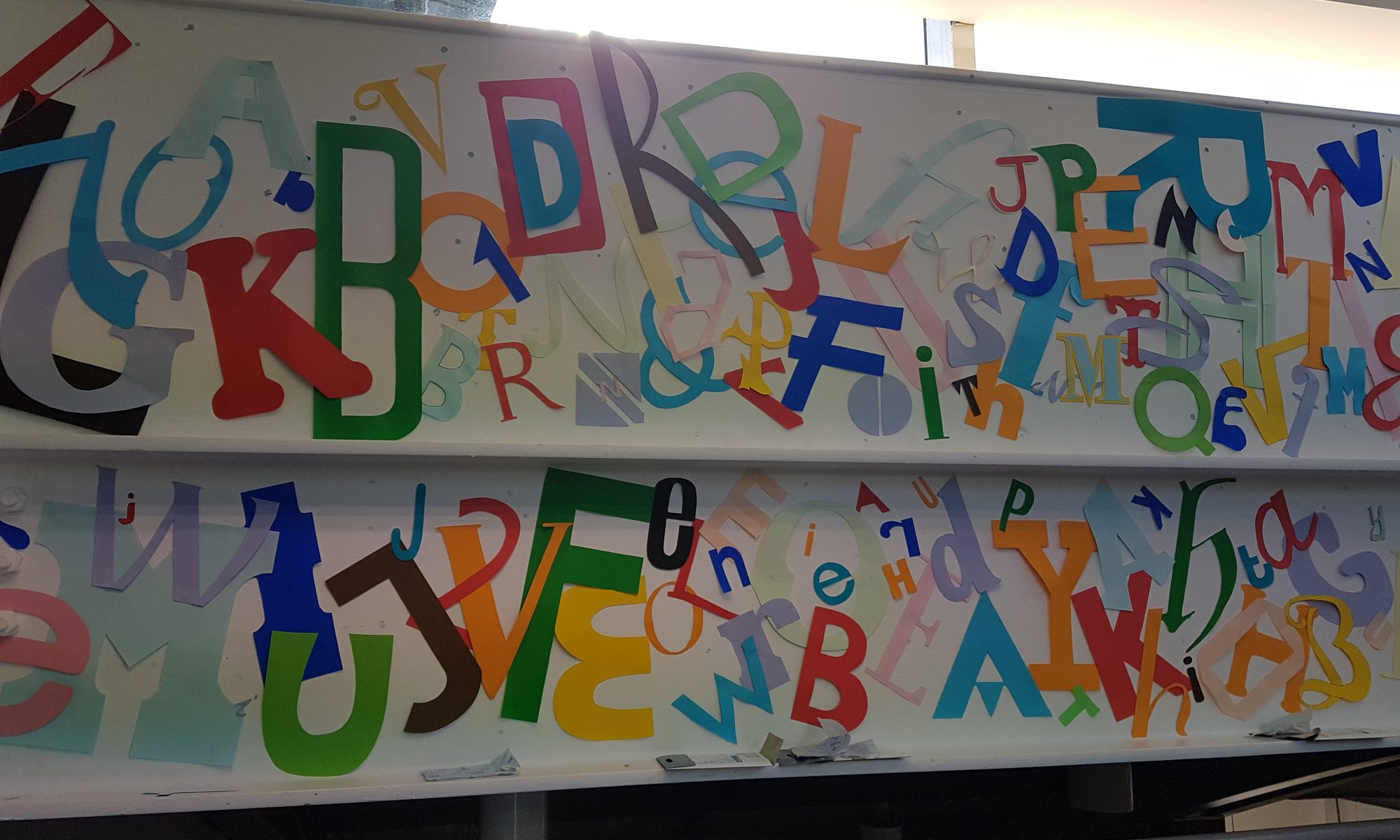
Photo: Shot in Cardiff, demonstrating an example of Clarendon letterforms within a commercial environment.


Triangular Serif

Triangular Serif

Triangular Serif typefaces contain serifs triangular in shape, and are the most common example of serif in modern typography. (Font: Editor, Designed by Jean-Baptiste Morizot, Published by Indian Type Foundry, 2016)


Bifurcated SerifBifurcated and Trifurcated Serifs

Bifurcated and Trifurcated serifs are serifs that are split into two and three respectively, creating a more embellished visual to the entire letterform and word. Their style is ornate and decorative and are often used for such purposes.


Vestigal

Vestigal

Vestigal typefaces contain letterforms with noticeable flairs and embellishments to create an attractive and decorative style.

Photo: Shot in Cardiff, demonstrating a window logo that uses a Vestigal typeface to promote its brand and attract customers.


Fat Face

Fat Face

Fat Face typefaces are often all caps, bold and are wider than they are tall. They were often used in advertising in 19th century Europe due to their stylistic nature and ability to stand out. (Font: HWT Roman Extended)


Nesting

Nesting

Nesting is a process in typography in which a smaller letter will sit entirely inside the boundaries of a larger one. (Font: Times New Roman)


Superior Letters

Superior Letters

Superior Letters are letterforms that dominate an area, and all subsequent letters will sit above its baseline and be smaller in scale. This can be often seen in abbreviations and dates, for example. (Font: Onyx)


Versals Lombardic

Versals Lombardic

Versals Lombardic is a style of decorative typography where a letterform will usually sit inside a frame and be accompanied by images or illustrations. They are often seen in books or fairytales and create a sense of grandeur through their style.

Anatomy of a Typeface

Anatomy of a Typeface

Cap height – The maximum height of  uppercase letterforms. Determines pt. size.

X-height – The height of the main body of a lowercase letterform.

Baseline – The line that most of the letterforms sit upon.

Serif – A line that sits at the end of some strokes.

Stem – A vertical stroke.

Crossbar – A horizontal stroke.

Ascender – Strokes that take the letterform above the typeface’s x-height.

Desecender – Strokes that take the letterform below the typeface’s baseline.

Bowl – A curved stroke on a letterform that connects back to its main body.

Ligature – Two or more letterforms are joined together to create a single glyph.

Aperture – An opening in the letterform.

Finial – A tapered or curved end to a stroke.

Hairline – Thinner strokes on an (often humanist) letterform.

Shoulder – A curved stroke originating from a stem.

Spine – The curved stroke of an ‘S’ letterform.


Information sourced from: Typedia.com. (2018). Typedia: Learn: Anatomy of a Typeface. [online] Available at: http://typedia.com/learn/only/anatomy-of-a-typeface/ [Accessed 26 Sep. 2018].

Design a site like this with WordPress.com
Get started